DECEMBER 26, 2024 • INTERSTATE 10, CALIFORNIA

Christian Riley Moreland
killed Yui Umehara-Garewal.

Christian Moreland got behind the wheel on just 3 hours of sleep in the last 36 hours, on one of the busiest travel days of the year. In less than an hour of driving, he fell asleep, crossed the median, and killed a wife and mother in front of her family. He lied to investigators about what happened. He's been charged with just a misdemeanor, and he's still free.

Who He Killed

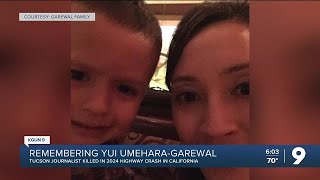
Yui Umehara-Garewal was 43 years old. She was a wife, a mother of two, a journalist, a tireless volunteer, and the heart of her community in Oro Valley, Arizona.

She spent nearly a decade as a copy editor at the Arizona Daily Star before choosing what she called "the most important job of her life" — raising her children.

Her friends describe her as someone who "made everyone around her feel so happy and loved." Her children's school principal said she "gave generously to our school by volunteering in her own children's classrooms, serving on our PTO Board, volunteering at nearly every event."

On December 26, 2024 — the day after Christmas — Yui was driving her family from Tucson to California to visit friends and family. At 2:50 PM, Christian Riley Moreland crossed the median on Interstate 10 and struck their vehicle head-on. Her husband, seated in the passenger seat, heard her last words — "oh shit" or "what the hell?" — as she saw the car coming.

Yui died instantly. Her two children survived with injuries. Their lives will never be the same.

Yui Umehara-Garewal
The Victim
Yui Umehara-Garewal
July 6, 1981 – December 26, 2024
Age 43

What Christian Riley Moreland Did

On December 26, 2024, Christian Riley Moreland, then 24 years old, got behind the wheel of a vehicle near Indio, California on just 3 hours of sleep in the last 36 hours.

He was so exhausted that he fell asleep at the wheel in less than 60 minutes.

His vehicle crossed the median on Interstate 10 near Desert Center, California — about 50 miles west of Blythe — and struck the Garewals' Honda minivan head-on. The impact killed Yui instantly and forced the vehicle into a semi.

Key Fact

At the scene, Moreland admitted to first responders and a witness that he had fallen asleep at the wheel. When witness Jim Caywood asked him what happened, Moreland stated plainly: "I fell asleep."

Official Documentation
CHP Collision Report - Page 23 showing official determination that Moreland's claim was false

California Highway Patrol Collision Report, Page 23 — CHP determined Moreland's story was false

Days later, when formally interviewed by California Highway Patrol investigators, Moreland changed his story. He claimed two tractor trailers had been in front of him, that one had struck his vehicle from behind, causing him to spin out and roll. He fabricated a specific detail: that the driver of the phantom truck had walked over to him after the crash and said, "You killed that woman."

When investigators asked him why he had said he fell asleep at the scene, Moreland dismissed it as "just a bad choice of words."

CHP Determination

The California Highway Patrol formally determined Moreland's claim was false, based on three pieces of evidence:

  • Dashcam footage from the semi-truck recorded the entire incident. It showed no other vehicles were anywhere near Moreland's car before he veered off the road.
  • Physical evidence — photographs of Moreland's vehicle showed no damage consistent with being struck by a tractor trailer as he described.
  • Multiple witnesses at the scene stated they did not observe any collisions before Moreland's car crossed the median.

Moreland lied to investigators to avoid responsibility for killing a woman and injuring her children.

The insurance company for the vehicle Moreland was driving hired investigators to locate him for settlement documents. After months of attempts at his last known address in Tempe and other possible locations, they came up empty.

Christian had run.

<60
Minutes before he fell asleep
1
Life taken
2
Others injured

Why This Is Not "Just an Accident"

Christian Moreland was charged with misdemeanor vehicular manslaughter under California Penal Code 192(c)(2) — which applies when someone commits an unlawful act with "ordinary negligence."

But what Moreland did wasn't ordinary negligence. Under California law, PC 192(c)(1) — felony vehicular manslaughter with gross negligence — applies when someone:

  • Acts in a reckless way that creates a high risk of death or great bodily injury
  • A reasonable person would have known that acting in that way would create such a risk
Consider the difference between drowsy driving and drunk driving:

Someone impaired by drugs or alcohol has compromised judgment — they may genuinely believe they're fine to drive. Their impairment affects their ability to assess their own impairment.

Someone who is severely sleep-deprived knows exactly how they feel. You know that feeling — when closing your eyes means instant sleep. When every part of your body is screaming for rest. Christian Moreland was in that condition when he decided to get behind the wheel. No substance impaired his judgment. He knew. He drove anyway.

The research is clear: driving severely sleep-deprived is as dangerous as driving drunk.
AAA Foundation for Traffic Safety:
  • • Missing 2-3 hours of sleep quadruples crash risk
  • • Less than 4 hours of sleep = 11.5x crash risk
  • • This is equivalent to driving with a BAC at or above the legal limit
California Office of Traffic Safety:

The state of California officially recognizes drowsy driving as a serious danger equivalent to impaired driving.

Christian Moreland was so fatigued when he got behind the wheel that he couldn't stay conscious for even an hour. The California Highway Patrol's official conclusion states the collision was caused by "a driving pattern consistent with someone falling asleep" — Moreland drifted onto the shoulder, then made an aggressive steering correction that sent him across the median.

Unlike impairment from alcohol or drugs, Moreland had no substances affecting his judgment about whether to drive. He was fully aware of his extreme fatigue when he made the decision to drive. He later admitted he usually gets 6-7 hours of sleep per night — and knew he had gotten far less.

He knew he was exhausted. He knew driving in that condition was dangerous. He drove anyway.

This wasn't a question of if he would hit someone. It was a question of when.

What Should Have Happened vs. What Did

What Should Have Happened
Felony Vehicular Manslaughter
PC 192(c)(1)
  • Up to 6 years in state prison
  • Felony record
  • Active warrant pursuit
  • Meaningful accountability
What Actually Happened
Misdemeanor Vehicular Manslaughter
PC 192(c)(2)
  • Up to 1 year in county jail (often probation)
  • Misdemeanor record
  • $5,000 bail
  • Warrant issued but not actively pursued
The Riverside County DA's office has indicated it's "difficult to prove gross negligence without drugs or alcohol involved."

But the CHP marked "SLEEPY/FATIGUED" as an impairment factor on the official collision report. Moreland admitted at the scene — to both first responders and a witness — that he fell asleep. He later lied to investigators about what happened. The science shows his level of sleep deprivation was equivalent to being legally drunk. If driving while impaired to the equivalent of being drunk isn't gross negligence, what is?

The Disparity in Justice

Consider how the system would have responded if Christian Moreland had been found with a small amount of cocaine in his car — not intoxicated, just possessing it:

Drug Possession (No Victim)
  • Arrested at the scene
  • Felony charges filed
  • Warrant actively pursued if fled
  • 2-4 years in state prison
Killing Someone While Driving (Actual Outcome)
  • Released at the scene
  • Misdemeanor charges filed
  • Warrant issued but not pursued
  • Up to 1 year county jail (often probation)

Simple drug possession — no accident, no victim — results in aggressive prosecution. Killing a wife and mother through reckless driving results in a warrant that sits in a drawer.

This is, in effect, a state-sanctioned hit and run.

Christian Moreland killed someone, left the state, and faces no meaningful pursuit. The system has decided that a mother's life is worth less than a baggie of powder.

The DA Behind the Decision: Mike Hestrin

Riverside County District Attorney Mike Hestrin has held office since 2015. His record reveals a pattern of aggressive prosecution in some cases — and troubling gaps in others.

When Hestrin Acts Aggressively
  • Fentanyl cases: Secured California's first-ever guilty verdict in a fentanyl-related homicide. Filed 30+ fentanyl homicide charges since 2021 — leading the state.
  • High-profile cases: Successfully prosecuted the Turpin "House of Horrors" parents, resulting in 25-to-life sentences.
When Hestrin Doesn't
  • 1,700+ cases dismissed in just six months (2022-2023) due to backlogs — 41% were DUIs, 23% were domestic violence.
  • Police shootings: Only 1 officer prosecuted out of 60+ community members killed by law enforcement since 2015.
  • The Costco case: Hestrin declined to prosecute an off-duty officer who shot and killed Kenneth French, a developmentally disabled man. The California AG charged the officer anyway. A federal jury awarded $17 million to the family.

The pattern is clear: Hestrin's office aggressively pursues cases that generate headlines. Cases that don't — including vehicular manslaughter without drugs or alcohol — fall through the cracks.

This isn't speculation. Hestrin's office has explicitly stated it's "difficult to prove gross negligence without drugs or alcohol involved." That's not a legal limitation — it's a policy choice. A mandate handed down to deputy DAs: no drugs, no felony.

The result? Christian Moreland was released at the scene. While the DA's office spent a year deciding whether to bother with charges, he got a head start. Now there's a warrant no one's serving for a killer no one's pursuing.

Yui Umehara-Garewal's case isn't an anomaly. It's the predictable outcome of a prosecutorial philosophy that treats some deaths as more worthy of justice than others.

For Riverside County voters: Ask yourself if you want Mike Hestrin, or if you want a DA who actually serves justice, not headlines.

Where Things Stand Now

Current Status
A warrant has been issued for Christian Moreland's arrest. He has not been apprehended.

The Criminal Case

  • Case Number: MIBL2500359
  • Charge: PC 192(c)(2) — Misdemeanor
  • Bail: $5,000 (not posted)
  • Court: Blythe, Riverside County
  • Status: Warrant issued, not served

About Christian Riley Moreland

Photo
  • Age: 24 at time of crash (born 2000)
  • Education: Arizona State University (graduated 2024)
  • High School: Westmont High School, San Jose, CA
  • Last Known Location: Tempe, Arizona (no longer there)
  • Father: Paul Rodney Moreland (formerly Beaverton, OR; now Buckeye, AZ)
Christian's Social Media

Pattern of Avoidance

At the scene (December 26, 2024): Moreland told first responders and witnesses the truth — that he was extremely sleep-deprived and fell asleep at the wheel.

CHP Interview (days later): Moreland changed his story and lied to investigators. The CHP's investigation caught him in that lie.

August – November 2025: Insurance investigators made repeated attempts to locate Moreland at his last known address in Tempe and other possible addresses. A neighbor indicated someone else may be living there now. He has been unlocatable.

December 2025: Court summons ignored. Warrant issued. Still not apprehended.

News Coverage

Demand Accountability

Contact the DA

Ask Riverside County DA: Why isn't Christian Moreland being pursued for killing someone?

Phone: (951) 955-5400

Address: 3960 Orange Street, Riverside, CA 92501

Email: pio@rivcoda.org

Reference Case MIBL2500359 — Christian Riley Moreland

You can also contact DA Mike Hestrin directly:
DA Mike Hestrin
Systemic Change

Sleep-deprivation should be treated like DUI

The science is settled: severe sleep deprivation causes impairment equivalent to drunk driving. Yet prosecutors across the country remain reluctant to charge drowsy driving as gross negligence. This case is not unique — it's a symptom of a system that treats vehicular death as an acceptable cost of doing business.

Contact your state representatives and demand that sleep-deprivation be prosecuted with the same seriousness as DUI. Yui Umehara-Garewal's death should not be in vain.

Share This Page

Help spread awareness. Every share increases the pressure for accountability.